
Introduction
Logistics has changed far beyond the traditional idea of transportation and delivery. In the past, logistics mainly focused on moving goods from one place to another. Today, modern logistics is a technology-driven business function that connects production, warehousing, transportation, inventory, customer service, data analysis and global trade.
Every product we use in daily life reaches us through a logistics and supply chain system. Whether it is food, medicine, mobile phones, online shopping products, automobiles or industrial materials, logistics plays a major role in making sure that the right product reaches the right customer at the right time.
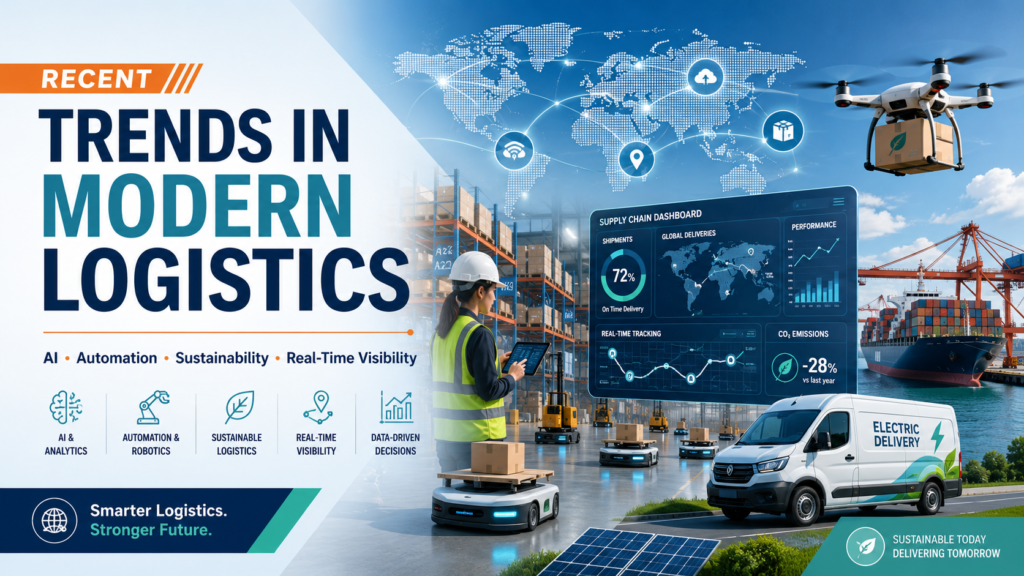
Modern logistics is now becoming smarter, faster and more data-driven. Companies are using artificial intelligence, automation, robotics, digital platforms, real-time tracking, electric vehicles and sustainable practices to improve efficiency and reduce cost. This transformation is creating new career opportunities for students and professionals who want to build a future in Logistics and Supply Chain Management.
Why Modern Logistics Is Important
Logistics is the backbone of business growth. A company may have a good product, strong marketing and high customer demand, but without an efficient logistics system, it cannot deliver products properly. Poor logistics can lead to delayed deliveries, stock shortages, high costs, customer complaints and business losses.
Modern logistics helps companies:
- Deliver products faster
- Reduce transportation and storage costs
- Improve inventory control
- Track shipments in real time
- Avoid delays and errors
- Improve customer satisfaction
- Make better business decisions using data
- Build stronger and more resilient supply chains
Today, logistics is not only about movement. It is about planning, coordination, technology, documentation, service quality and continuous improvement.
1. Artificial Intelligence in Logistics
Artificial Intelligence, commonly known as AI, is one of the biggest trends in modern logistics. AI helps companies analyse large amounts of data and make better decisions. It can support demand forecasting, route planning, inventory management, warehouse operations, delivery scheduling and customer support.
For example, AI can predict which products may have high demand during a particular season. Based on this prediction, companies can maintain the right stock level and avoid shortage or excess inventory. AI can also help logistics companies select better delivery routes by considering traffic, distance, fuel consumption and delivery priority.
In logistics, AI is mainly used for:
- Demand forecasting
- Route optimization
- Inventory planning
- Warehouse slotting
- Delivery time prediction
- Customer service chatbots
- Document checking
- Risk identification
- Predictive maintenance of vehicles and equipment
AI does not remove the need for human professionals. Instead, it supports logistics teams by providing better information and faster insights. This means future logistics professionals should understand both operations and basic digital tools.
2. Warehouse Automation and Robotics
Warehouses are becoming smarter and more automated. Earlier, most warehouse activities were handled manually. Workers had to receive goods, arrange stock, pick products, pack orders and prepare dispatches using manual systems. Today, many companies are using warehouse management systems, barcode scanners, RFID, conveyor belts, automated storage systems and robots.
Warehouse automation helps companies process orders faster and reduce human errors. This is especially important in e-commerce, retail, pharmaceuticals, FMCG and manufacturing sectors where thousands of orders may need to be handled daily.
Common examples of warehouse automation include:
- Barcode and QR code scanning
- RFID-based inventory tracking
- Automated picking systems
- Conveyor systems
- Warehouse robots
- Automated guided vehicles
- Digital stock management
- Voice-based picking
- Smart shelves
- Warehouse Management System software
Automation improves speed and accuracy, but trained professionals are still required to supervise operations, manage systems, analyse reports and solve practical issues.
3. Real-Time Tracking and Supply Chain Visibility
One of the most important trends in modern logistics is real-time visibility. Customers and companies now expect to know where their shipment is, when it will arrive and whether there is any delay.
Real-time tracking uses GPS, IoT sensors, mobile applications, transport management systems and digital dashboards. These tools help logistics teams monitor shipments, vehicles, containers and delivery performance.
Real-time visibility is useful because it helps companies:
- Track goods during movement
- Identify delays early
- Inform customers quickly
- Monitor vehicle location
- Improve delivery planning
- Reduce theft and loss
- Improve accountability
- Analyse logistics performance
In international trade, real-time tracking is also important for container movement, port operations, customs clearance and documentation follow-up. For students learning logistics, understanding tracking systems and visibility tools is very important.
4. Green Logistics and Sustainability
Sustainability has become a major focus in logistics. Companies are now trying to reduce fuel usage, carbon emissions, packaging waste and environmental impact. This trend is called green logistics or sustainable logistics.
Green logistics includes practices such as:
- Using electric delivery vehicles
- Optimizing routes to reduce fuel consumption
- Using recyclable packaging
- Reducing empty vehicle movement
- Improving warehouse energy efficiency
- Using solar-powered warehouses
- Combining multiple shipments to reduce trips
- Choosing multimodal transport options
- Measuring carbon footprint
Many companies are also focusing on ESG goals, which means Environmental, Social and Governance standards. In the coming years, logistics professionals may need to understand sustainability reporting, green procurement, carbon reduction and responsible supply chain practices.
Green logistics is not only good for the environment. It can also reduce operational costs and improve brand reputation.
5. Growth of E-Commerce and Last-Mile Delivery
E-commerce has completely changed the logistics industry. Customers now expect fast, safe and trackable delivery. This has created huge demand for last-mile delivery, which means the final stage of delivery from a warehouse or hub to the customer.
Last-mile delivery is one of the most challenging parts of logistics because it directly affects customer satisfaction. Delays, wrong addresses, failed delivery attempts and poor communication can create negative customer experience.
Modern last-mile logistics uses:
- Delivery apps
- Route optimization
- Delivery tracking links
- Micro-fulfilment centres
- Local delivery hubs
- Electric bikes and vans
- Customer notification systems
- Proof of delivery technology
For students, this is an important career area because e-commerce, food delivery, grocery delivery, pharma delivery and retail distribution are continuously expanding.
6. Digital Supply Chain Platforms
Digital platforms are transforming logistics by connecting different stakeholders in one system. Earlier, logistics operations were often managed through phone calls, paper documents, emails and manual follow-ups. Today, companies are using digital platforms to manage transport, warehouse, inventory, documentation, payments and customer communication.
Digital logistics platforms help in:
- Shipment booking
- Freight comparison
- Vehicle allocation
- Warehouse management
- Inventory control
- Invoice and document management
- Vendor coordination
- Customer updates
- Performance reporting
Digitalization improves transparency and reduces manual errors. It also helps management make faster decisions because data is available in one place.
In India, digital logistics is receiving strong attention through government and industry initiatives. This creates better opportunities for logistics companies, startups, transporters, exporters and supply chain professionals.
7. Data Analytics in Logistics
Data is now one of the most valuable assets in logistics. Every shipment, warehouse movement, delivery delay, customer complaint and inventory transaction creates data. When this data is analysed properly, companies can improve their operations.
Logistics data analytics can answer questions such as:
- Which route is more cost-effective?
- Which warehouse has high order delay?
- Which product has frequent stock shortage?
- Which transporter gives better delivery performance?
- Which location has high demand?
- What is the average delivery time?
- Where can cost be reduced?
Data analytics helps logistics professionals move from guesswork to fact-based decision-making. This is why skills like MS Excel, Power BI, ERP awareness and dashboard understanding are becoming useful in logistics careers.
8. Multimodal Logistics
Multimodal logistics means using more than one mode of transport to move goods efficiently. For example, a shipment may move through road, rail, sea and inland waterways depending on distance, cost and time.
Multimodal logistics is important because relying only on road transport may increase cost and congestion. A better combination of road, rail, ports and waterways can improve efficiency.
Benefits of multimodal logistics include:
- Lower transportation cost
- Better long-distance movement
- Reduced road congestion
- Improved cargo handling
- Better connectivity
- Lower environmental impact
- Improved supply chain reliability
India is focusing strongly on multimodal logistics through infrastructure development, logistics parks, port modernization, industrial corridors and digital systems. This will increase the requirement for skilled logistics professionals in the coming years.
9. Cold Chain Logistics
Cold chain logistics is another fast-growing area. It involves the storage and transportation of temperature-sensitive products such as medicines, vaccines, frozen foods, dairy products, fruits, vegetables and seafood.
Cold chain logistics requires strict temperature control, monitoring and documentation. A small temperature change can damage the product and create financial loss.
Important areas in cold chain logistics include:
- Refrigerated storage
- Temperature-controlled vehicles
- Cold rooms
- Pharma logistics
- Food supply chain
- Sensor-based monitoring
- Quality control
- Compliance documentation
Kerala and India have strong opportunities in food, healthcare, pharma and export-related cold chain logistics. Students who learn logistics can explore career roles in this specialized area as well.
10. Resilient Supply Chains
Recent global disruptions have taught companies an important lesson: supply chains should not only be low-cost, they should also be strong and flexible. Natural disasters, pandemics, wars, fuel price changes, port delays, shipping issues and supplier problems can affect business operations.
This is why companies are now building resilient supply chains. A resilient supply chain can handle disruptions and recover quickly.
Companies are improving resilience by:
- Using multiple suppliers
- Keeping safety stock for critical products
- Improving supplier relationships
- Using digital risk monitoring
- Creating backup transport plans
- Diversifying sourcing locations
- Improving demand forecasting
- Developing flexible warehouse networks
For logistics professionals, problem-solving and risk management skills are becoming more important than ever.
11. Blockchain and Secure Documentation
Logistics involves many documents, especially in international trade. Shipping documents, invoices, customs documents, bills of lading, certificates and contracts need accuracy and trust.
Blockchain is an emerging technology that can help improve transparency and security in logistics documentation. It can create a secure digital record of transactions, making it difficult to alter or manipulate information.
Although blockchain is still developing in logistics, it may become useful in:
- Trade documentation
- Shipment verification
- Product traceability
- Customs clearance
- Supplier records
- Food and pharma supply chains
- High-value cargo tracking
Students do not need to become blockchain experts, but understanding digital documentation and secure information flow will be helpful.
12. Career Opportunities Created by Modern Logistics
The growth of modern logistics is creating many career opportunities. Companies need trained people who understand operations, technology, documentation, customer service and supply chain coordination.
Some career roles include:
- Logistics Executive
- Supply Chain Executive
- Warehouse Coordinator
- Inventory Executive
- Procurement Assistant
- Purchase Coordinator
- Transport Coordinator
- Documentation Executive
- Shipping Executive
- Freight Forwarding Executive
- E-commerce Logistics Coordinator
- Last-Mile Delivery Coordinator
- Operations Executive
- Vendor Management Executive
- Distribution Executive
- Import and Export Documentation Assistant
With experience, professionals can grow into positions such as:
- Logistics Manager
- Warehouse Manager
- Supply Chain Manager
- Procurement Manager
- Distribution Manager
- Operations Manager
- Transport Manager
- Inventory Manager
Modern logistics offers opportunities in manufacturing, retail, e-commerce, shipping, ports, airports, healthcare, FMCG, automotive, warehousing, courier companies and third-party logistics companies.
Skills Required for Modern Logistics Careers
To succeed in modern logistics, students should develop both practical and professional skills.
Important skills include:
- Communication skills
- Basic computer knowledge
- MS Excel knowledge
- Coordination ability
- Problem-solving skills
- Documentation knowledge
- Time management
- Customer service mindset
- Inventory understanding
- Transport coordination
- Analytical thinking
- Adaptability to technology
A successful logistics professional should be able to coordinate with people, understand data, handle pressure and solve operational problems.
Why Students Should Learn Logistics Now
Logistics is a career-focused field because it is directly connected to real business operations. Every company needs movement of goods, storage, purchase, inventory, documentation and delivery. This makes logistics relevant across many industries.
Students who complete Plus Two, diploma or graduation can consider Logistics and Supply Chain Management if they are interested in:
- Job-oriented courses
- Business operations
- Warehouse and inventory management
- Shipping and documentation
- E-commerce and delivery operations
- Procurement and purchase
- International trade
- Practical career growth
Modern logistics is also suitable for working professionals who want to upgrade their career or shift into a growing industry.
How GISE Supports Logistics Career Training
Global Institute of Skill Excellence, also known as GISE, offers career-focused online training programs designed to help students and working professionals build industry-relevant skills.
The Logistics and Supply Chain Management program at GISE focuses on practical learning and professional development. The course helps learners understand logistics fundamentals, warehouse management, inventory control, procurement, transportation, shipping documentation, supply chain coordination, soft skills and career preparation.
GISE focuses on:
- Online learning accessibility
- Industry-oriented syllabus
- Expert faculty support
- Practical logistics concepts
- Career guidance
- Soft skill training
- Placement assistance
- Student-friendly learning approach
The aim of GISE is to make professional education accessible and useful for learners who want to build a strong career in modern industries.
Conclusion
Modern logistics is moving towards a smarter, faster and more sustainable future. Technologies such as AI, automation, real-time tracking, digital platforms and data analytics are changing the way companies manage supply chains. At the same time, sustainability, resilience, multimodal logistics and customer-focused delivery are becoming major priorities.
For students, this transformation creates a strong opportunity. Logistics is no longer just about transport; it is a professional field that combines business, technology, planning, communication and problem-solving.
A good logistics course can help students understand the industry and prepare for career opportunities in India and abroad. As businesses continue to grow and supply chains become more advanced, trained logistics professionals will play an important role in the future.